Nuevo artículo: Potential of Mobile LiDAR Sensors in Hiking Trail Management | Sensors
Investigadores de la Universidade do Porto (Portugal) y tGIS exploran la potencialidad de los sensores LiDAR integrados en teléfonos móviles para la evaluación de caminos naturales
18 ago 2026 - 12:05 CET
Autoes: Rui Fernandes, Alberto Gomes, Borja Moya-Gómez y Nelson Mileu
Resumen / Abstract
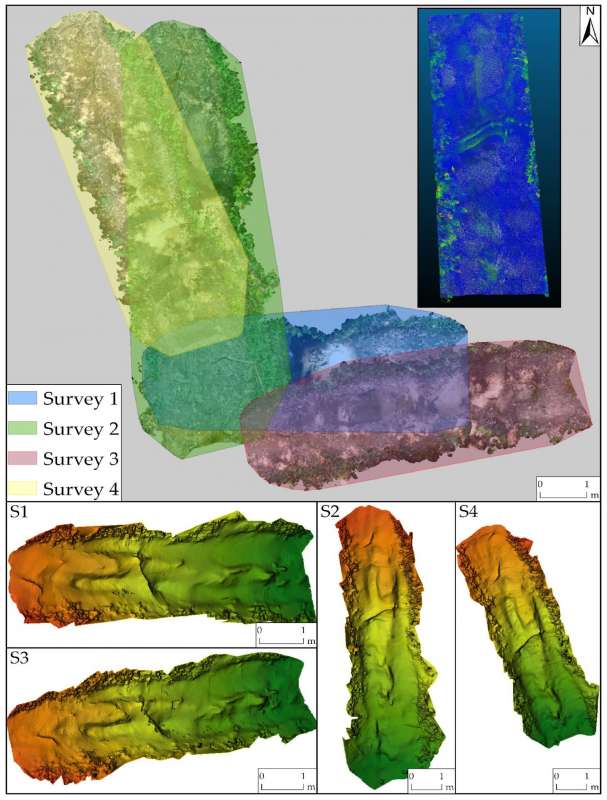
The LiDAR sensor embedded in recent iPhone Pro devices offers new opportunities for rapid, low-cost, and spatially detailed assessment of outdoor recreational infrastructure. Framed within mobile sensing and IoT-based environmental monitoring, this proof-of-concept case study evaluates a smartphone-based LiDAR workflow for localized hiking trail assessment under dense canopy conditions. Four independent surveys of a degraded hiking trail section were conducted to assess inter-survey repeatability, agreement with conventional field measurements, and practical field applicability. The resulting three-dimensional models reproduced trail morphology, including incised tread sections, exposed roots, rocky surfaces, and localized irregularities relevant to trail-condition assessment. Repeated registrations demonstrated consistent cloud-to-cloud comparison metrics, while comparisons with field reference measurements showed good agreement in the representation of cross-sectional morphology and exposed root characteristics. Continuous surface reconstruction additionally supported exploratory identification of potential runoff pathways and relative surface depressions. Although limited to a single trail section and one smartphone–application combination (iPhone 13 Pro with Scaniverse), the evaluated workflow demonstrates potential as a rapid, accessible, and relatively low-cost approach for localized trail-condition assessment and provides a foundation for further evaluation in hiking trail monitoring.
Idioma: Inglés
¿Cómo citarlo? Fernandes, R., Gomes, A., Moya-Gomez, B., & Mileu, N. (2026). Potential of Mobile LiDAR Sensors in Hiking Trail Management. Sensors, 26(16), 5143. https://doi.org/10.3390/s26165143