Nuevo artículo: Advancing land use mix through complementarity: the Parcel Complementarity Model (PCM) | Computational Urban Science
La UPM y tGIS presentan un nuevo modelo para optimizar la diversificación de usos del suelo según el uso previsto y los desplazamientos de acceso/egreso
3 abr 2026 - 21:22 CET
Autores: Haithem Drici, y José Carpio-Pinedo
Resumen / Abstract
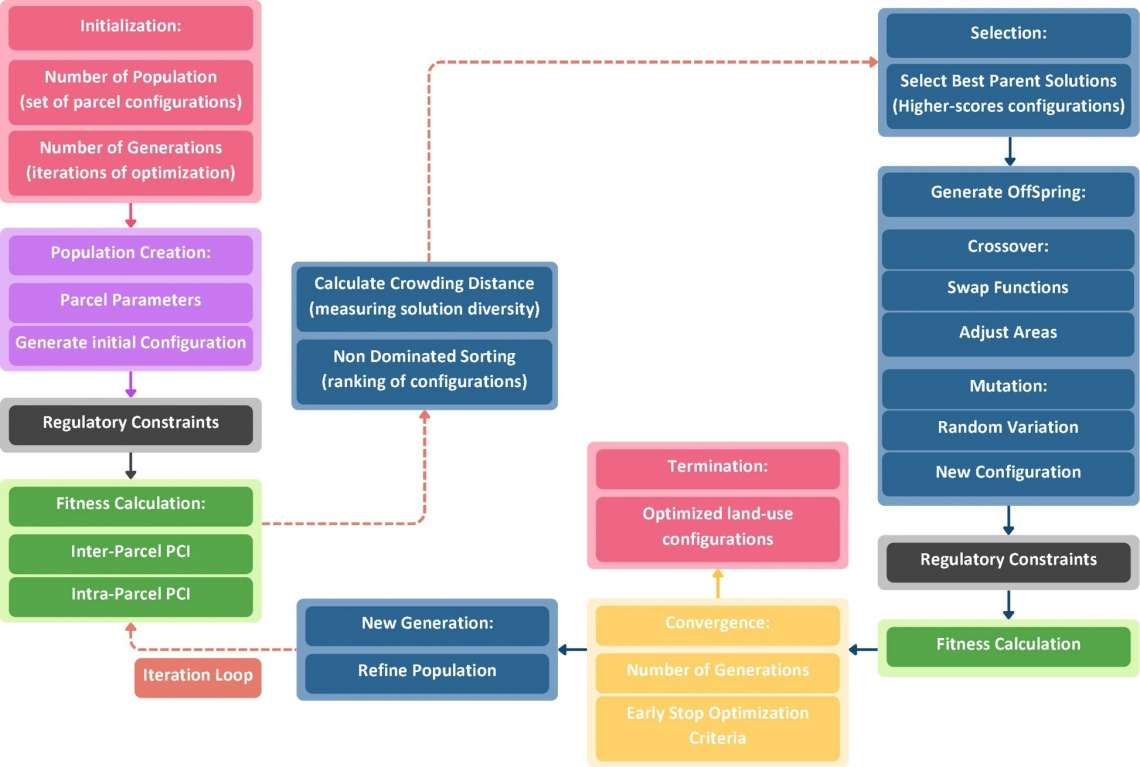
This paper introduces the Parcel Complementarity Model (PCM), a parcel-level analytical tool for evaluating and optimising land use mix through observed patterns of use and movement. Rather than relying on compositional measures such as land use mix diversity or proportional balance, PCM conceptualises land use mix as a system of functional complementary interaction shaped by asymmetric trip flows, visit frequency, and spatial adjacency. Using cadastral land use data and mobility survey data from the Madrid metropolitan area, the model quantifies both inter-parcel and intra-parcel complementarity through a Parcel Complementarity Index (PCI). PCM is applied to vacant parcels in Tres Cantos (Spain), which are treated as gaps within existing neighbourhood-scale functional complementarity sets rather than as isolated development opportunities. A multi-objective optimisation process is used to explore alternative land use allocation and configuration scenario under existing regulatory constraints. The results show that improvements in land use mix complementarity depend less on the presence of additional uses and more on how land uses are positioned and configured in relation to surrounding parcels and existing functional interaction patterns. PCM provides a transparent and replicable method for evaluating parcel-level complementarity and supporting early-stage planning decisions grounded in empirical use and movement relationships.
Enlace: https://link.springer.com/article/10.1007/s43762-026-00256-7
Idioma: Inglés
¿Cómo citarlo? Drici, H., Carpio-Pinedo, J. (2026). Advancing land use mix through complementarity: the Parcel Complementarity Model (PCM). Computational Urban Science, 6, (26).