Nuevo artículo: How life satisfaction interacts with travel satisfaction and perceived accessibility in an underdeveloped urban region | Urban, Planning and Transport Research
UPM y tGIS muestran resultado de como afecta la percepción de acceso al transporte público en la satisfacción del viaje en Lahore (Pakistán)
16 ene 2026 - 16:58 CET
Autores: Hamza Yasin, Inmaculada Mohino, y José Carpio-Pinedo
Resumen / Abstract
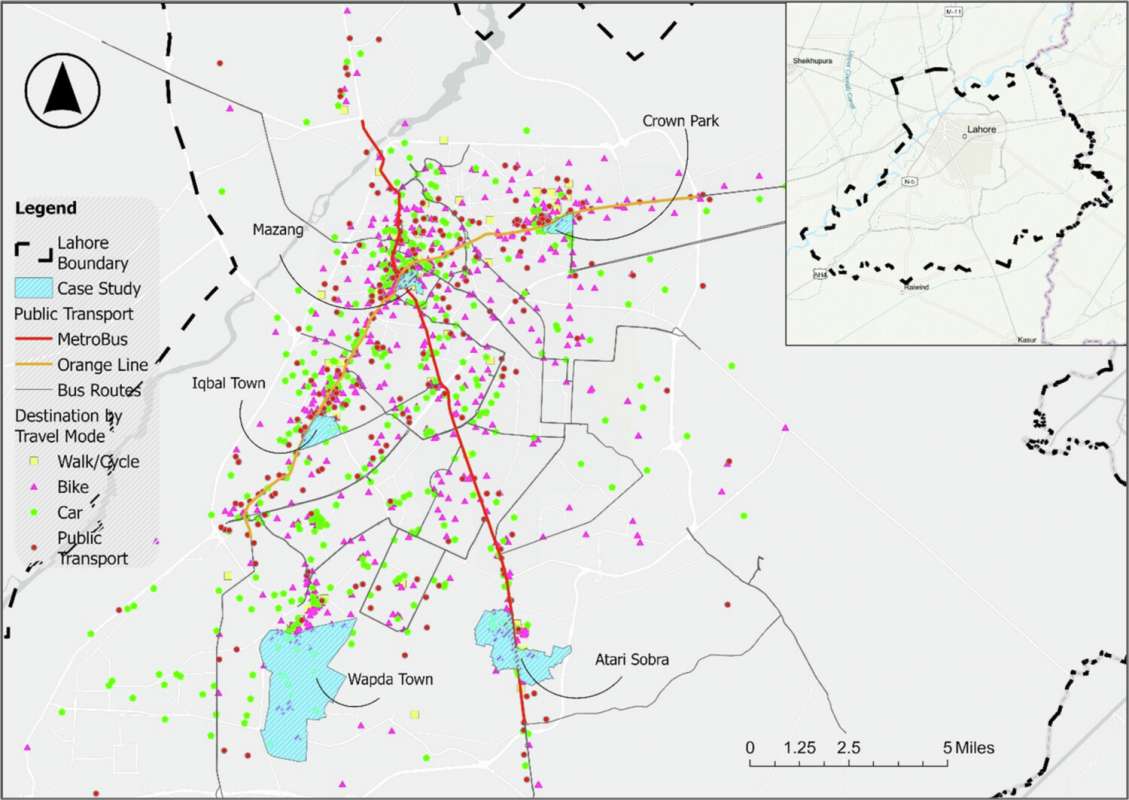
While the relationship between daily travel and life satisfaction has been widely studied, its implications for transportation planning and policy remain significant. In this study, we extend the existing research by exploring how perceptions of accessibility via public transport influence both travel satisfaction and life satisfaction within a developing world context. A household travel survey was conducted in five neighborhoods of Lahore, Pakistan—encompassing both compact and sprawled areas—where 1,512 respondents provided retrospective insights into their daily travel satisfaction, perceived accessibility, and life satisfaction. Geographic coordinates of their travel destinations were collected and used to compute journey times through network analysis using the r5py library in Python. The direct and indirect effects of travel attributes, travel satisfaction, and perceived accessibility on life satisfaction were then analyzed using variance-based structural equation modeling with SMART PLS 4.0. Findings revealed that longer travel times were linked to lower levels of travel satisfaction, perceived accessibility, and life satisfaction. Additionally, in comparison to private modes of travel, active travel modes and public transportation were found to have more positive effects on travel satisfaction, perceived accessibility, and life satisfaction.
Enlace: https://www.tandfonline.com/doi/full/10.1080/21650020.2026.2613555
Idioma: Inglés
¿Cómo citarlo? Yasin, H., Mohino, I., & Carpio-Pinedo, J. (2026). How life satisfaction interacts with travel satisfaction and perceived accessibility in an underdeveloped urban region. Urban, Planning and Transport Research, 14(1), 2613555.