New publication in Parasites & Vectors
21 oct 2026 - 09:43 CET
Rafael Calero-Bernal, Martha Ynés Salas-Fajardo, Mercedes Fernández-Escobar, Ana Huertas-López, Sabrina Castro-Scholten, Javier Caballero-Gómez, Fernando Nájera, Elena Crespo, Amalia García-Talens, Rebeca Grande-Gómez, Irene Zorrilla, Isabel Fernández-Verón, Jorge Peña, María Jesús Palacios, David González-Barrio, Miguel Ángel Habela, Guillermo López, Javier Salcedo, Rodrigo Serra, Isabelle Villena, Gereon Schares, Gema Álvarez-García, Ignacio García-Bocanegra, Luis Miguel Ortega-Mora
Background
The Iberian lynx (Lynx pardinus) is one of the world’s most endangered felid species. To date, no attempt to either isolate viable Toxoplasma gondii or identify the genotypes circulating in this emblematic felid species has been carried out. The present study aimed at estimating the extent of the T. gondii infection in Iberian lynxes, to genotype the strains circulating in wild and captive lynxes in the Iberian Peninsula, and to unravel the degree of genetic overlapping with other strains previously characterized from wild and domestic animals in the study area.
Methods
Anti-Toxoplasma antibodies in lynx sera were evaluated using a modified agglutination test and a western-blot assay, showing high inter-test agreement. Toxoplasma gondii presence in muscle tissues was determined by qPCR, and mouse bioassay was used for strain isolation. Genetic characterization of strains and T. gondii–PCR-positive tissue samples was carried out through PCR–RFLP, PCR-sequencing, and microsatellites fragment analysis methods. Additional population analyses were performed through Minimum Spanning Network analyses and Affinity Propagation Clustering (APC) based on Bruvo’s distance matrix.
Results
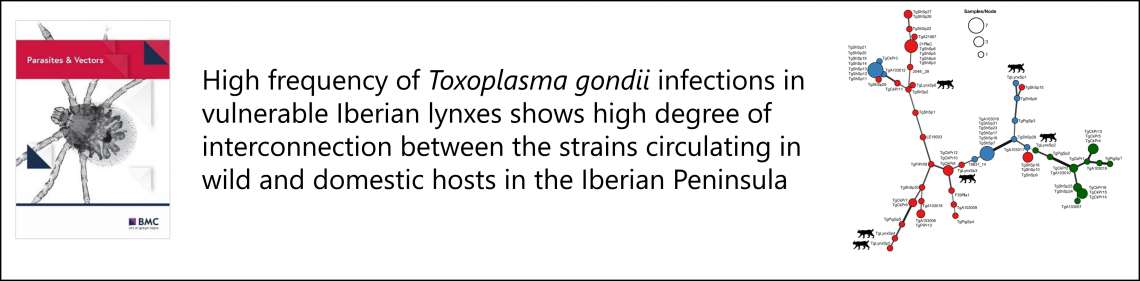
Anti-T. gondii antibodies were detected in 44.2% (238/538) of lynxes, T. gondii DNA was present in 17% of tissue samples of 176 animals, and viable parasites were isolated from tissues of six out of 44 individuals of unknown serostatus. By PCR–RFLP, genotypes ToxoDB #3 (5/6 isolates) and #2 (1/6 isolates) were identified; subsequent microsatellite subtyping analyses identified 5 Type II variants, and 1 Type III variant. Additional attempt of direct MS-typing of 3 T. gondii–DNA positive samples allowed identifying one additional Type II variant. Complementary genotyping of virulence-related markers (GRA7, CS3, ROP5/ROP18) evidenced presence of alleles previously associated with phenotypes of intermediate-to-non-virulent strains. Phylogenetic analyses demonstrated genetic proximity between lynx-derived strains and those previously identified in other wild and domestic animals in the Iberian Peninsula.
Conclusions
Iberian lynxes contribute to the genetic diversity observed in the study area, where a notable degree of interconnection between wild and domestic life cycles is evident when comparing strains from some of the compartments of the One Health approach.