New publication in Veterinary Parasitology
14 sep 2026 - 13:25 CET
Diagnostic approach for early Toxoplasma gondii infection in pregnant sheep based on IgM serology
A. Huertas-López, R. Sánchez-Sánchez, N. Velasco-Jiménez, R. Calero-Bernal, L.M. Ortega-Mora, J. Benavides, D. Gutiérrez-Expósito, G. Álvarez-García
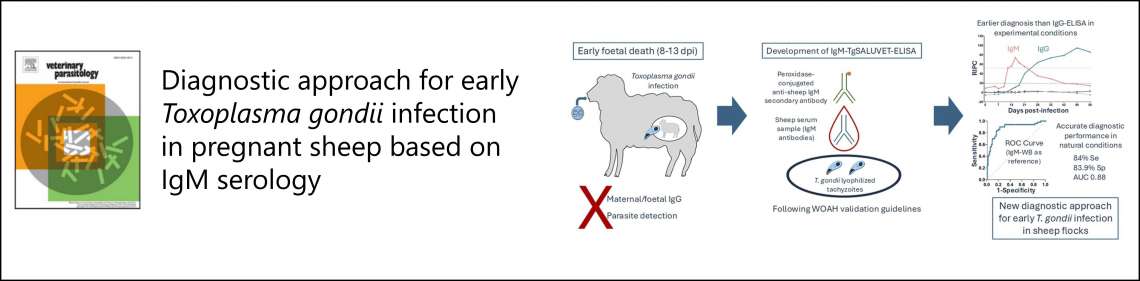
IgM detection is commonly employed for early diagnosis in human congenital toxoplasmosis. In small ruminants, accurate methods are needed to identify early foetal death (8–13 days post-infection), which often occurs without IgG seroconversion and parasite detection in the foetuses. The study aimed to develop and validate an ELISA based on lyophilized Toxoplasma gondii tachyzoites to detect anti-T. gondii IgM antibodies (IgM-ELISA) for sheep sera following WOAH guidelines. Using IgM-Western Blot (IgM-WB) as a reference test, sera panels comprising 735 sera from sheep experimentally- and naturally-infected with either T. gondii or other abortifacient pathogens were used. The IgM-TgSALUVET-ELISA demonstrated successful analytical validation, showing excellent precision (CV < 5%), good accuracy (R2 = 0.85–0.96) and analytical sensitivity (detection limit: DO = 0.1). While IgM-WB showed no cross-reactivity between T. gondii antigens and anti-Neospora caninum and anti-Chlamydia abortus antibodies, IgM ELISA yielded false positives. IgM kinetics analyses in T. gondii experimentally-infected sheep enabled early diagnosis capability of IgM-ELISA and IgM-WB, detecting IgM immunoglobulins at 10 and 13 dpi, aligning with the early abortion timeframe. The IgM-ELISA achieved 84% diagnostic sensitivity, 83.9% specificity, AUC = 0.88, and substantial agreement with IgM-WB (Kappa = 0.61). Field investigations based on paired and sequential IgM/IgG comparisons suggest the IgM detection is useful as a marker of recent T. gondii infection after excluding other abortifacient pathogens. However, prolonged anti-T. gondii IgM persistence may complicate the interpretation of results. In sum, the IgM-ELISA test showed good performance under the conditions tested, although potential interferences limit its use as a stand-alone assay. Therefore, a sequential diagnostic approach in the event of suspected foetal death during early T. gondii infection in a flock is proposed.