New publication in Veterinary Immunology and Immunopathology
30 jun 2026 - 10:06 CET
Marta Silva, Noive Arteche-Villasol, Miguel Criado, Luis Miguel Ortega-Mora, Julio Benavides, Daniel Gutiérrez-Expósito
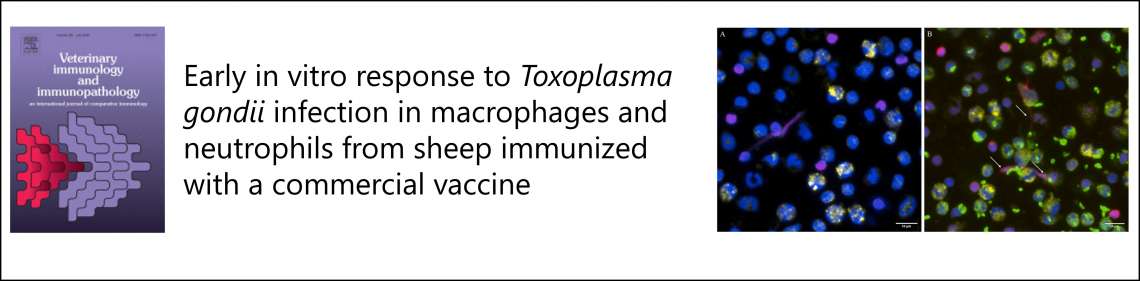
Although commercial vaccination against ovine toxoplasmosis (Ovilis® Toxovax) has been used to prevent the disease for decades, the mechanisms behind this protection and its effects on target immune cells such as macrophages and neutrophils remain poorly understood. Therefore, peripheral blood monocytes and neutrophils were obtained from vaccinated (n = 5) and non-vaccinated (n = 5) sheep. Ovine monocyte-derived macrophages (OvMØs) were first differentiated in vitro. Neutrophils and OvMØs were inoculated with different T. gondii isolates: TgShSp1 (type II, ToxoDB#3), TgShSp24 (type III, ToxoDB#2) and S48 (type I, Ovilis® Toxovax) and incubated for 3 and 8 h, respectively. Interleukins (ILs) 12, 6, 10 and 1β, along with tumor necrosis factor (TNF), TLR2, TLR8 and macrophage inflammatory protein-1beta (MIP-1β) were significantly upregulated in OvMØs from non-vaccinated sheep compared to vaccinated sheep. However, the transcription levels of iNOS were upregulated in OvMØs from vaccinated ewes. The response of the OvMØs was similar within each group regardless the T. gondii isolate. Similarly, transcription levels of TNF, IL-1β, IL-8, TLR2 and TLR4 were upregulated in neutrophils from non-vaccinated sheep, however no differences in the quantification through fluorimetry of extracellular DNA derived from NETs were observed. These results suggest that vaccination predispose macrophages and neutrophils towards a contained immune response against T. gondii, although it could enhance parasite elimination by macrophages through a higher intracellular production of nitric oxide. Further in vitro studies involving parasite quantification in these cell populations might help to better understand its role in the immune response after vaccination.