New publication in Scientific Reports
18 may 2026 - 10:18 CET
Andrea Largo-de la Torre, Natalia Velasco-Jiménez, Luis Miguel Ortega-Mora, Javier Regidor-Cerrillo
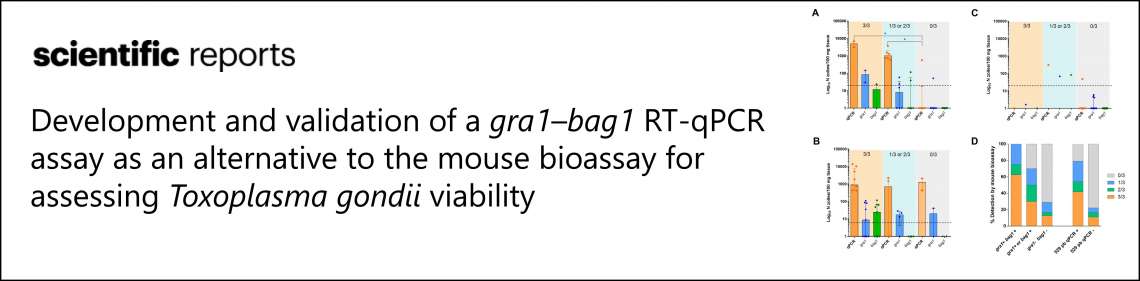
Toxoplasmosis is a major foodborne zoonosis causing high global disease burden and economic losses in sheep and goat industries. The gold standard for detecting viable Toxoplasma gondii is the mouse bioassay, which involves inoculating tissues from infected animals into laboratory mice. Here, we describe a faster, cost-effective, and ethical alternative method to assess T. gondii presence and viability. The procedure is based on reverse transcription quantitative PCR (RT-qPCR) targeting messenger RNA transcripts of genes highly expressed during infection, including the bradyzoite-specific gene bag1, indicative of chronic infection and gra1, which detects both acute and chronic infections due to high transcription in tachyzoites and bradyzoites. This RT-qPCR assay was evaluated alongside the mouse bioassay and two molecular methods, 529 bp-specific qPCR and nested ITS-1 PCR, using tissues from experimentally infected piglets and sheep. Cohen’s kappa coefficient showed moderate agreement between gra1–bag1 RT-qPCR and the mouse bioassay (κ = 0.557), comparable to 529-qPCR (κ = 0.556). The assay detected gra1 and bag1 transcripts in all bioassay-positive samples, demonstrating high predictive value for viable parasites. The gra1–bag1 RT-qPCR provides a reliable prescreening tool for predicting parasite viability in tissues, supporting ethical research by reducing reliance on the mouse bioassay.