New publication in International Journal for Parasitology
17 ene 2026 - 12:08 CET
NcROP24 loss attenuates Neospora caninum virulence and alters rhoptry organization
Rafael Amieva, Laura Rico-San Román, Montserrat Coronado, Jessica Powell, Musa A. Hassan, Andrew Hemphill, Ghalia Boubaker, Christiane Pfarrer, Luis Miguel Ortega-Mora, Esther Collantes-Fernández, Pilar Horcajo
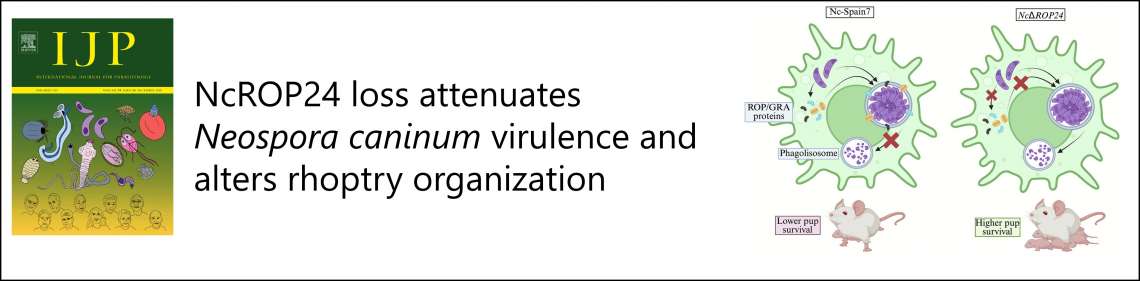
Neospora caninum is an apicomplexan parasite responsible for bovine neosporosis, a leading cause of abortion and economic loss in cattle worldwide. Despite its veterinary significance, the molecular mechanisms underlying parasite virulence and host-pathogen interaction remain poorly understood. In particular, the contribution of rhoptry proteins, key secretory effectors involved in host cell invasion and immune modulation, has yet to be fully elucidated. Here, we investigate NcROP24, a previously understudied rhoptry protein whose expression correlates with isolate virulence. Using CRISPR/Cas9, we generated NcROP24 knock-out mutants (NcΔROP24) by deleting all three genomic copies and confirmed loss of expression with a single‐copy insertion of a selectable marker DHFR-TS. In a pregnant mouse model, NcΔROP24 parasites displayed markedly reduced congenital transmission, higher neonatal survival, and lower maternal brain parasite burdens compared to wild‐type controls, demonstrating significant attenuation of systemic and vertical infection. Also, in bovine monocyte‐derived macrophages, NcΔROP24 tachyzoites showed impaired intracellular growth. Dual RNA‐seq of infected macrophages revealed that NcΔROP24 loss prevents the parasite from reprogramming key host metabolic and degradative pathways, instead promoting a stress‐induced, lipogenic state that favours clearance. Concurrently, parasites lacking NcROP24 upregulated stress‐associated transcripts and downregulated additional secreted effectors, indicating a shift away from aggressive proliferation. Together, these findings establish NcROP24 as a key factor of N. caninum pathogenicity. By defining its role in host-pathogen interactions, our work highlights NcROP24 as a promising target for next‐generation vaccines or therapeutics against bovine neosporosis.