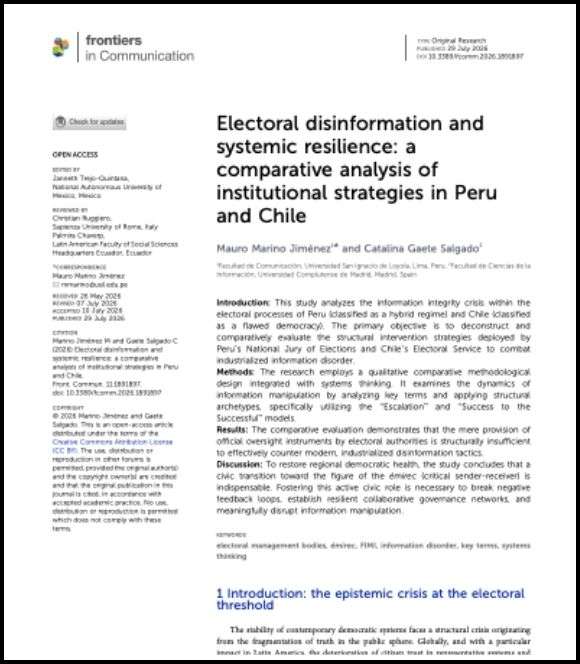
Electoral disinformation and systemic resilience: a comparative analysis of institutional strategies in Peru and Chile
7 sep 2026 - 12:58 CET
Autores
Mauro Marino-Jiménez, https://orcid.org/0000-0003-2541-0447
Catalina Gaete-Salgado: https://orcid.org/0000-0002-2112-2643
Resumen
Introduction: This study analyzes the information integrity crisis within the electoral processes of Peru (classified as a hybrid regime) and Chile (classified as a flawed democracy). The primary objective is to deconstruct and comparatively evaluate the structural intervention strategies deployed by Perus National Jury of Elections and Chiles Electoral Service to combat industrialized information disorder. Methods: The research employs a qualitative comparative methodological design integrated with systems thinking. It examines the dynamics of information manipulation by analyzing key terms and applying structural archetypes, specifically utilizing the “Escalation” and “Success to the Successful” models. Results: The comparative evaluation demonstrates that the mere provision of official oversight instruments by electoral authorities is structurally insufficient to effectively counter modern, industrialized disinformation tactics. Discussion: To restore regional democratic health, the study concludes that a civic transition toward the figure of the émirec (critical sender-receiver) is indispensable. Fostering this active civic role is necessary to break negative feedback loops, establish resilient collaborative governance networks, and meaningfully disrupt information manipulation.
Accede al recurso en el siguiente enlace: https://www.frontiersin.org/journals/communication/articles/10.3389/fcomm.2026.1891897/full
Cita en formato APA: Marino Jiménez M and Gaete Salgado C (2026) Electoral disinformation and systemic resilience: a comparative analysis of institutional strategies in Peru and Chile. Front. Commun. 11:1891897. doi: 10.3389/fcomm.2026.1891897